
Suitefy Team | 7 minute read
NetSuite rarely stays still. As headcount climbs, transaction volume grows, and customizations accumulate, the way a business supports the platform has to evolve with it. For NetSuite Alliance Partners and the growing companies they serve, a support model that worked at go live starts to crack the moment the business outgrows the one administrator who knew every script and saved search.
A support model that cannot scale shows up in familiar ways:
- A single administrator becomes a bottleneck, and a single point of failure the moment they take leave
- A client expands into NetSuite OneWorld, adding subsidiaries, currencies, and tax jurisdictions
- A growing library of SuiteScript 2.1, workflows, saved searches, and integrations needs ongoing maintenance rather than one time delivery
- A partner finishes go live and the client expects day two operations without missing a beat
- The twice yearly NetSuite release cycle (for example 2026.1 and 2026.2) demands testing and readiness every six months
The models below are ordered from the simplest (and least scalable) to the most robust. Each involves a different trade off between cost, scalability, and access to expertise. There is no single right answer, only the right fit for where the business is today and where it is heading.
Note: This post focuses on ongoing support operations, not the initial implementation project. It assumes NetSuite ERP is already live in production. The principles apply whether support is delivered fully in house, fully by a partner, or co managed. At Suitefy, we deliver these support models on behalf of NetSuite partners, so the framing here reflects what we see across 100+ projects and 200+ customers worldwide.
1. Reactive admin support, simple and direct
In the earliest stage, one in house administrator or power user handles issues as they arise. A user raises a problem over email or chat, the admin fixes it, and everyone moves on. No tooling, no process, no overhead.
This works at small scale because the admin holds the entire account in their head. That strength is also the weakness: knowledge lives in one person, work is purely reactive, and there is no record of what was fixed, why, or how often the same issue recurs.
Trade off: Cheapest and fastest to operate, but it does not scale. It is a single point of failure, offers no continuity if the admin leaves, and keeps the team firmly in firefighting mode with no path to proactive improvement.
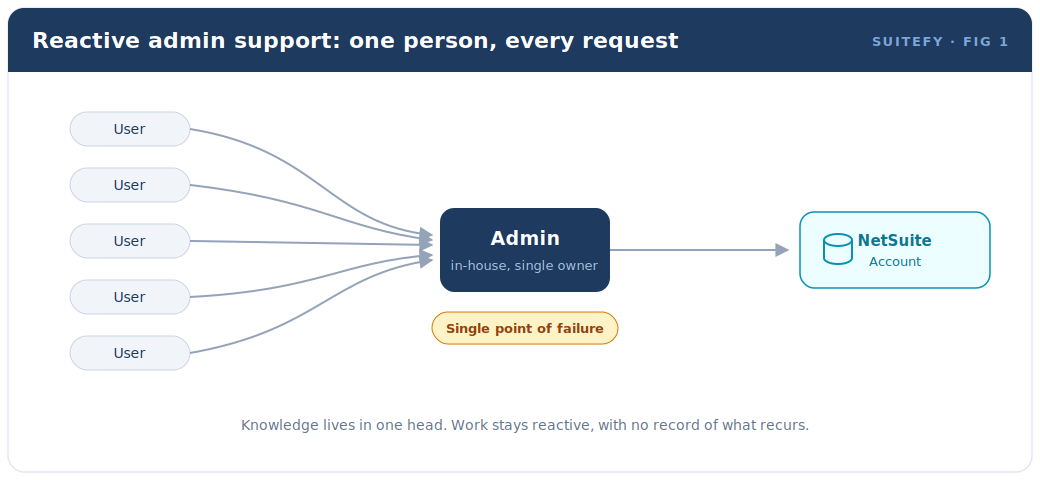
Figure 1: With reactive admin support, every request funnels through one person, and nothing is recorded for next time.
2. Structured internal helpdesk, order and visibility
The first real step up is to formalize intake. Requests flow through a ticketing tool instead of scattered messages, each ticket carries a category and priority, and a lightweight internal knowledge base captures recurring fixes alongside SuiteAnswers.
This brings two things reactive support cannot: visibility and repeatability. You can finally see what is breaking, how often, and where time is going, which is the data needed to justify the next investment.
Trade off: Brings order, accountability, and reporting, but the model is still bounded by internal capacity and skill depth. When a problem needs SuiteScript debugging or integration expertise the team does not have, the ticket simply waits.
Tip: Do not over engineer the ticketing setup. A clear priority matrix (P1 to P4), a handful of categories that match how your team actually thinks, and one owner for triage will outperform an elaborate workflow nobody follows.
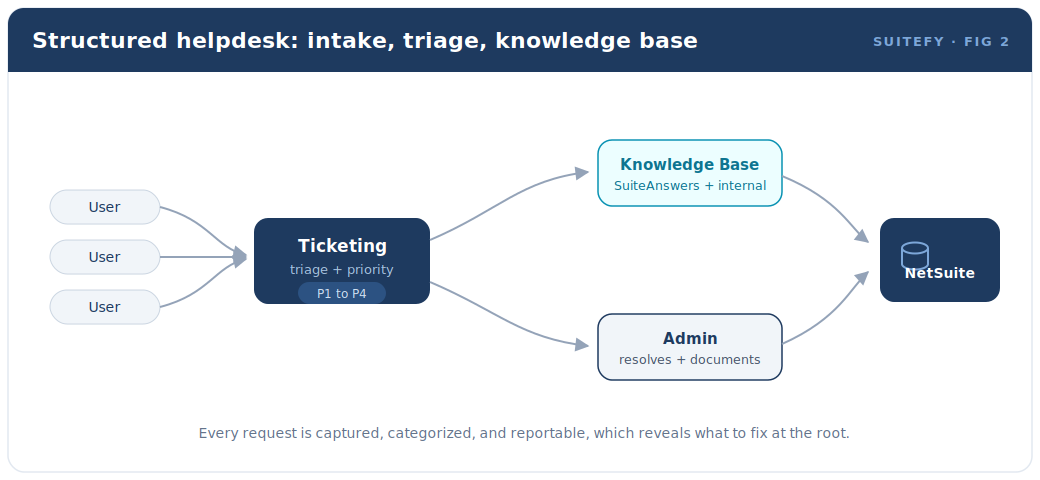
Figure 2: A structured helpdesk captures, triages, and routes every request, building a reusable knowledge base along the way.
3. Tiered support model (L1 to L3) with SLAs, scaling with complexity
As volume and complexity grow, a flat team gives way to defined tiers, each with its own scope and skill profile:
- Level 1 handles triage, access and role requests, known fixes, and how to questions, resolving the high volume, low complexity tickets that would otherwise drown specialists
- Level 2 covers functional configuration: roles and permissions, forms and fields, saved searches, workflow adjustments, and standard reporting
- Level 3 owns the technical layer: SuiteScript 2.1, RESTlets, SuiteCloud deployments, integrations, and performance issues
Defined SLAs set response and resolution expectations by priority, and clear escalation paths ensure tickets move up only when they genuinely need to. This is also the first model that scales cleanly across partner teams, because tiers create a shared language for handoffs.
Trade off: Scales with both volume and complexity and supports collaboration across internal and partner teams, but it demands process discipline, well defined roles, and enough ticket volume to justify the structure. Too much process too early just adds friction.
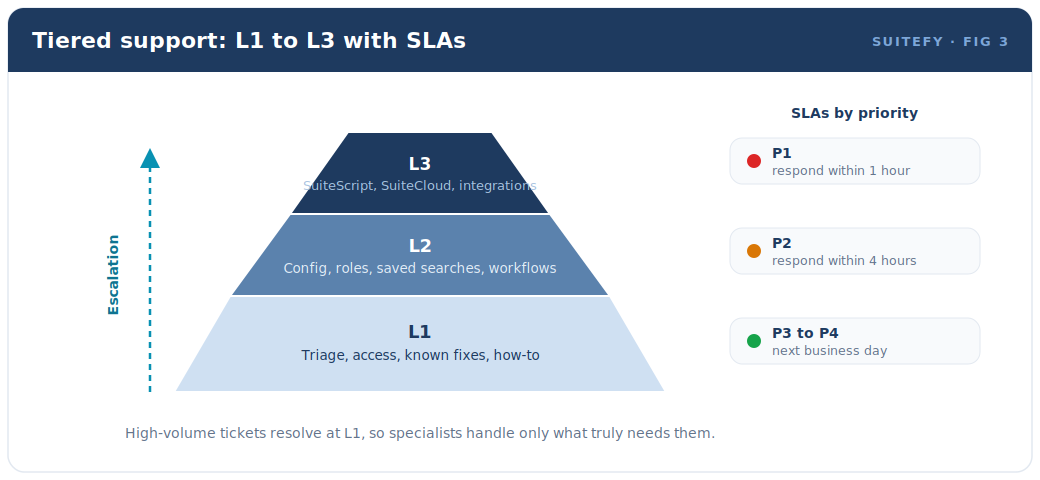
Figure 3: Tiered support resolves high-volume tickets at L1 and escalates only what genuinely needs L2 or L3 expertise.
4. Partner augmented managed services, the scalable approach
The most scalable model blends internal ownership with on demand partner expertise, often delivered as NetSuite Managed Services or through Staff Augmentation. The business retains accountability and product knowledge, while a partner supplies depth across functional and technical specialties and, critically, capacity that flexes with demand.
This is exactly the model Suitefy delivers on behalf of NetSuite partners. Our certified NetSuite Functional Consultants, Technical Consultants, and Administrators plug into existing teams, while delivery centers across the United States, India, Australia, and the Middle East make genuine follow the sun coverage possible. When a P1 lands at the close of a US business day, work continues rather than waiting for morning.
Done well, this is also the first genuinely proactive model. Instead of waiting for tickets, the team monitors release readiness, retires technical debt, and plans for the next phase of growth. You stop paying only to keep the lights on and start paying to make the system better.
Trade off: Highest scalability, predictable cost, and access to deep expertise without the overhead of hiring specialists full time, but it requires clear governance, well defined responsibilities, and a strong, trust based partner relationship. A poorly governed engagement just outsources the chaos.
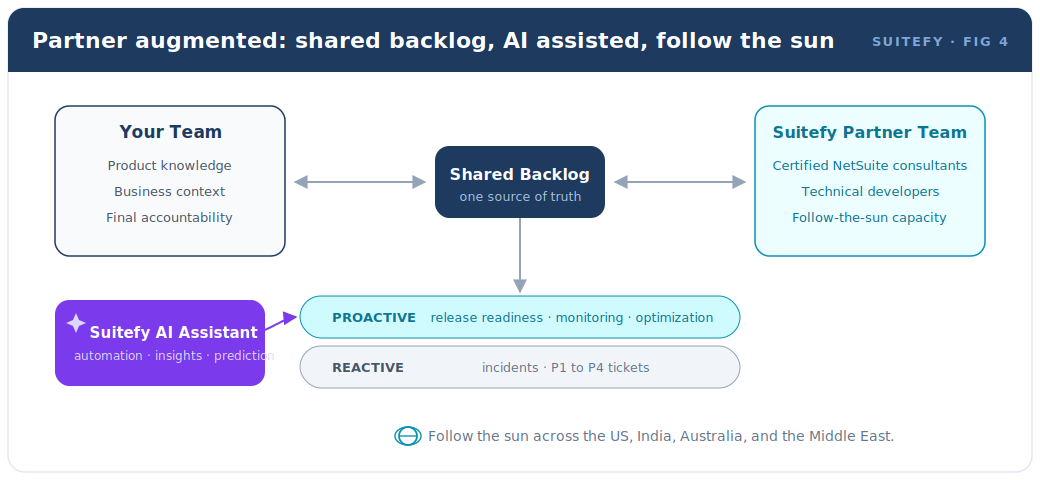
Figure 4: A co-managed model shares one backlog across your team and Suitefy, with AI lifting both reactive and proactive work.
Working with partner teams: shared responsibility done right
The four models above describe how much support you build. The moment a partner enters the picture, whether co managing Level 3 or running the entire desk, who owns what becomes the deciding factor between a smooth engagement and a frustrating one. For white label and partner led delivery, this clarity matters even more, because the end client sees one seamless service regardless of who sits behind it.
A few principles consistently separate the two outcomes:
- Define ownership explicitly. A simple RACI across functional configuration, technical development, integrations, and release testing prevents the “I thought you had it” gap that silently breaks things.
- Govern access deliberately. Use least privilege NetSuite roles, named partner logins (never shared accounts), and periodic access reviews. Partner access should be auditable and revocable on the first day of offboarding, not a fire drill later.
- Coordinate environments and change. Agree on sandbox refresh timing, a deployment path (SuiteCloud CLI or SDF), and a change control gate so two teams never overwrite each other in production.
- Keep one shared backlog. A single source of truth for tickets and enhancements, visible to both sides, beats parallel lists that quietly diverge.
- Make knowledge transfer bidirectional. The partner documents what they build; the internal team documents the business context. Continuity should never depend on one individual on either side.
Where AI changes the support equation
The newest lever in scalable NetSuite support is intelligent automation. The Suitefy AI Assistant brings AI driven insights, workflow automation, and predictive analytics directly into the NetSuite experience, and each of those maps cleanly onto a stronger support model:
- Deflection at Level 1. AI handles routine how to questions and surfaces the right SuiteAnswers article instantly, freeing specialists for the work that actually needs them.
- Automation of repetitive workflows. Recurring manual steps are automated, which reduces both ticket volume and the human error that creates new tickets.
- Proactive, predictive monitoring. Predicting trends from your business data lets the team act before an issue becomes an incident, which is the difference between reactive and proactive support.
AI does not replace the tiered model; it makes every tier faster and lifts the whole operation toward the proactive end of the spectrum.
The essentials every model needs
Regardless of which model fits, a few foundations carry across all of them:
- A living knowledge base: SuiteAnswers for platform questions, plus an internal base for your specific customizations and integrations
- A priority matrix and SLAs, so “urgent” means the same thing to everyone
- A release readiness process, because NetSuite ships two major releases a year and each one deserves a planned, tested rollout rather than a surprise
- Change management and sandbox discipline, so no untested change ever reaches production
- Metrics that drive decisions: ticket volume, mean time to resolution, deflection rate, and CSAT tell you when it is time to move to the next model
Comparison
The table below summarizes the four models across the dimensions that matter most when deciding where to invest next.
Dimension | Reactive Admin | Internal Helpdesk | Tiered + SLAs | Partner Augmented |
|---|---|---|---|---|
Scalability | Low | Low to Medium | High | Very High |
Cost predictability | Low | Medium | Medium | High |
Proactive capability | None | Minimal | Some | Strong |
Expertise depth | Limited | Limited | Medium | Deep |
Setup complexity | Very Low | Low | Medium | Medium |
Best fit | Single entity, low volume | Growing, one region | Multi entity, customized | Complex, scaling, partner led |
How to choose
Match the model to your reality, not your ambition. A single entity with a handful of users and few customizations is well served by a structured helpdesk. Once subsidiaries, meaningful SuiteScript, or live integrations enter the picture, tiered support with SLAs becomes worth the process overhead. And when release cycles, integration maintenance, and growth plans start outrunning internal capacity, a partner augmented model delivers depth and flexibility without the cost of building a full specialist bench in house.
The trap to avoid is staying in a model you have already outgrown. The clearest signal is when the same issues keep recurring and no one has time to fix the root cause. That is the moment to move up a tier.
Conclusion
A scalable NetSuite support model is not about buying the most support; it is about matching structure to complexity. Start simple, formalize as volume grows, tier as complexity grows, and bring in partner expertise (now amplified by AI) when proactive improvement matters more than keeping the lights on. Each step trades a little more structure for a lot more resilience, and the businesses that scale NetSuite smoothly are the ones that recognize the right moment to take the next step.
Learn More
NetSuite Managed Services: administration, customizations, upgrades, and proactive monitoring delivered on your behalf
Staff Augmentation: certified NetSuite consultants, developers, and administrators who scale your team on demand
Suitefy AI Assistant: AI driven insights, automation, and predictive analytics built into NetSuite
Ready to scale your NetSuite support without scaling your headcount? Talk to the Suitefy team about a co managed support model built around your roadmap.
Suitefy is the strategic ally to NetSuite partners. Since 1998 we have delivered NetSuite implementation, customization, integration, managed services, staff augmentation, and AI across wholesale distribution, manufacturing, retail, high tech, bio tech, food and beverage, e commerce, and financial services, from offices in the United States, India, Australia, and the Middle East.