
For two decades, NetSuite teams have built their operations on workflows. SuiteFlow state changes, scheduled scripts, approval routings, and saved searches have quietly carried the load of day-to-day execution. Those mechanisms are dependable, but they share one defining limit: they only do exactly what they are told, in exactly the order they are told to do it. The moment a transaction falls outside the rule, a human has to step in.
AI agents change that equation. Instead of following a fixed path, an agent reads context, weighs options, decides, and acts inside NetSuite, escalating to a person only when judgment genuinely requires one. This is the practical difference between traditional NetSuite Automation and the new generation of intelligent workflows. For NetSuite Alliance Partners and their end users, it is also the most significant shift in ERP Automation since the move to the cloud.
At Suitefy, where we have delivered NetSuite implementation, customization, integration, and managed services since 1998, we are watching this transition reshape how customers run procurement, finance, service, and decision making. Here is what is actually changing on the ground.

From Rules That React to Agents That Reason
A classic NetSuite workflow is reactive. A purchase order hits a threshold, so it routes for approval. A customer record changes, so a field updates. The logic is valuable, but it is also brittle. Every exception, every edge case, and every “it depends” still lands in a person’s queue.
Intelligent workflows behave differently. An AI agent does not just trigger on an event, it interprets the event. It can pull related records, compare against historical patterns, reason about the right next step, and complete multi-step tasks that previously needed a finance analyst, a buyer, or a support specialist. The workflow engine still matters (agents often act through SuiteScript, SuiteFlow, and the SuiteTalk and REST APIs), but the decision layer now sits on top of it.
For partners advising clients, the framing is simple: workflows automate the steps, AI Agents automate the judgment between the steps.
Procurement Agents: Buying That Thinks
Procurement is one of the clearest wins for AI Agents inside NetSuite, because it is full of repetitive decisions that still demand context.
A procurement agent can monitor inventory positions, open sales orders, and vendor lead times, then draft purchase orders before a stockout ever appears on a dashboard. It can read an incoming vendor bill, match it against the purchase order and item receipt (a true three-way match), flag the variance that matters, and route only the genuine exceptions for human approval. It can compare quotes across preferred vendors, factor in on-time delivery history, and recommend a source rather than simply recording the one a buyer already chose.
The result is not a faster version of the old process, it is a smaller process. Buyers stop spending their day on data entry and matching, and start spending it on supplier strategy and exception handling. This is where the line between NetSuite Automation and ERP Automation becomes real: the system is no longer just recording procurement, it is participating in it.
Finance Agents: Closing Faster, With Confidence
The month-end close is where finance teams feel the weight of manual work most acutely. Reconciliations, accruals, intercompany entries, and variance investigations consume days that the business would rather spend on analysis.
Finance agents compress that cycle. An agent can reconcile bank feeds against NetSuite transactions, surface unmatched items with a probable explanation, and prepare draft journal entries for review. It can investigate budget-versus-actual variances by drilling into the underlying transactions and summarizing why a line moved, rather than leaving an analyst to chase it manually. During close, it can run through a checklist of recurring tasks, complete the routine ones, and hand the judgment calls to the controller with the context already assembled.
Crucially, well-designed finance agents do not operate as a black box. They keep an audit trail, respect role-based permissions, and pause at a human confirmation gate before posting anything material. That governance layer is what makes intelligent workflows safe to run in a system of record like NetSuite, and it is exactly the kind of control Suitefy builds into every automation we deliver.
Customer Service Automation: Resolution, Not Just Routing
Traditional customer service automation in NetSuite has mostly meant routing: assign the case to the right queue, set a status, send a templated reply. Helpful, but the customer is still waiting on a person to actually resolve the issue.
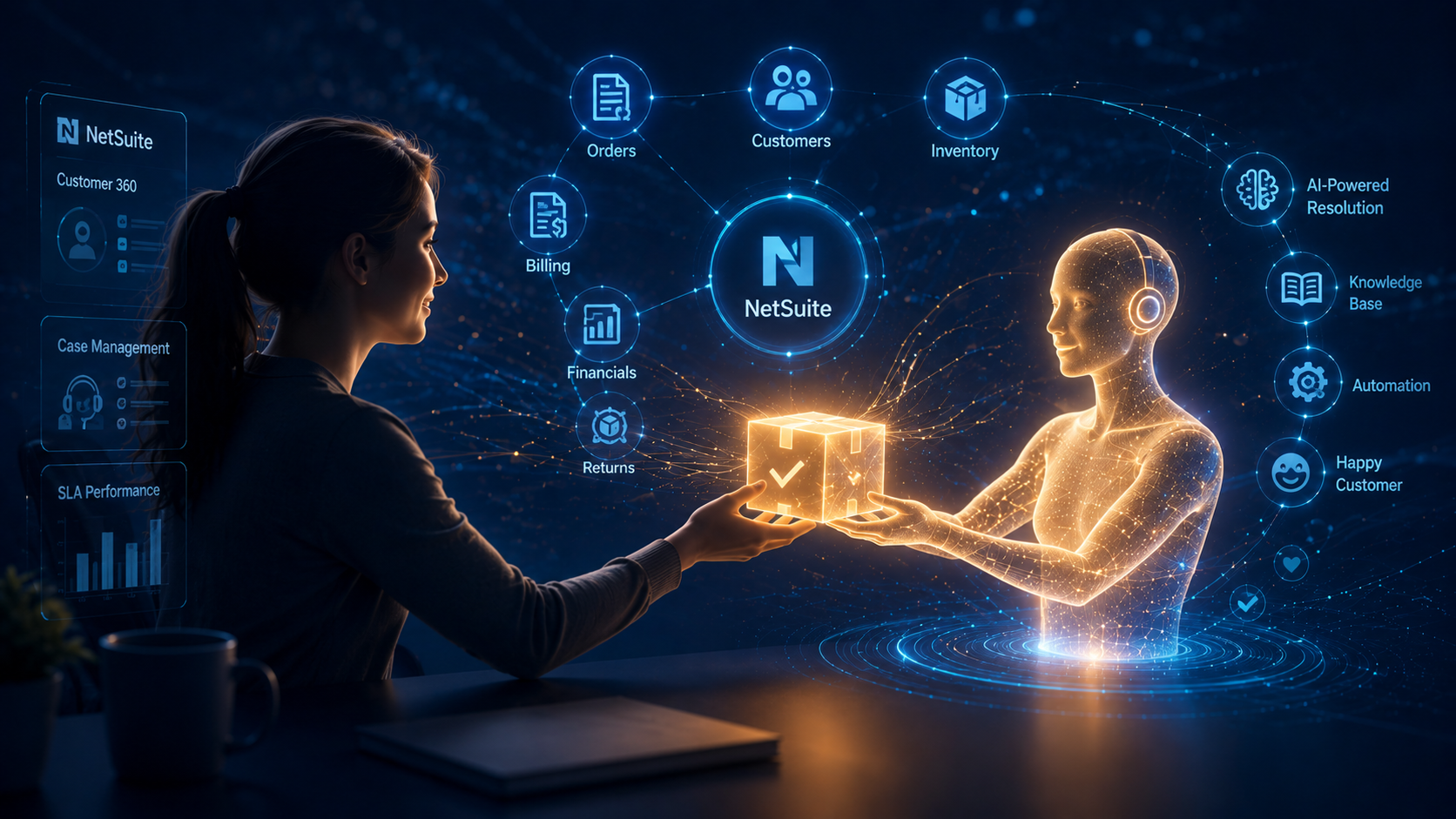
AI Agents move service from routing to resolution. An agent can read an inbound case, look up the customer’s orders, fulfillments, and invoices in NetSuite, and answer order-status or billing questions directly. It can triage by sentiment and priority, draft an accurate, context-aware response for an agent to approve, or handle straightforward requests end to end. When a return or credit is warranted, it can prepare the transaction and present it for confirmation rather than making the representative rebuild it from scratch.
For the end user, this means faster first responses and fewer handoffs. For the support team, it means human attention is reserved for the conversations that actually need empathy and discretion. The Suitefy AI Assistant is designed around exactly this principle: do the heavy lifting inside NetSuite, then bring a person in at the moment that matters.
AI-Driven Decision Making: From Reports to Recommendations
The deepest change is not in any single department, it is in how decisions get made across the whole NetSuite footprint. For years, the platform has been excellent at producing reports and saved searches. Someone still had to read them, interpret them, and decide.
AI-driven decision making closes that gap. Agents can continuously watch the metrics that matter (margin erosion, aging receivables, slow-moving inventory, customer churn signals) and proactively raise a recommendation with the reasoning attached, rather than waiting for a human to run the report. They turn dashboards from rear-view mirrors into forward-looking advisors. A leader no longer asks “what happened last quarter,” they receive “here is what is trending, here is the likely cause, and here is the action I recommend.”
This is the genuine promise of intelligent workflows: NetSuite stops being a place you go to look things up and becomes a partner that tells you what deserves your attention.
What This Means for NetSuite Partners and Their Customers
None of this replaces good NetSuite engineering, it depends on it. Agents are only as reliable as the data model, the permissions, the integrations, and the guardrails underneath them. Poorly governed automation in a system of record is a liability, not an asset. That is precisely why implementation experience matters more in the agent era, not less.
This is the work Suitefy has done for more than 25 years. Across our offices in the USA (Wilmington, Delaware), India (Hyderabad), Australia (Bella Vista, NSW), and the Middle East (Abu Dhabi, UAE), our teams have delivered 100-plus projects for 200-plus customers with a 100 percent success rate, spanning implementation, customization, data migration, integration, managed services, and staff augmentation. We pair that foundation with the Suitefy AI Assistant so partners can offer their end users not just NetSuite Automation, but genuinely intelligent operations.
The shift from workflows to agents is well underway. The partners who move first, with the right governance and the right implementation discipline, will define what modern ERP Automation looks like for the next decade.
If you are a NetSuite Alliance Partner exploring AI Agents for your customers, Suitefy can help you design intelligent workflows that are safe, auditable, and built to last. Let us show you what NetSuite operations look like beyond workflows.